
Picture this. You’re in the paint section of your friendly hardware store, eyeing forty shades of ‘greige’ and a little voice tells you, is one color not good enough for every place? Save a trip. Save some cash.
Don’t do it. Not unless you like buffing and repainting it every year.
Quick answer on the difference between interior and exterior paint? Manufacturers formulate interior paint with hard resins to improve washability and reduce VOCs. Exterior paint employs flexible resins that expand and contract with the weather, as well as UV blockers and mildewcides for protection against sun, rain, and humidity. Swap them, and you’re courting trouble — cracked siding, foggy indoor air or both.
That’s the short version. Let’s have a look at everything else you need to know before reaching for a roller.
What is interior paint?
Interior paint is made for one thing and one thing only — looking nice and standing up to the climate of a house. It features stabilizing insulation throughout, so the most damage it endures is just a heavy application of crayon from a toddler.
It leans on rigid resins. Resin can be thought of as the adhesive (the glue) holding pigment to your wall. By using a stiffer resin, the surface should resist scuffs and tiptoes (and that weird spot by every light switch your family touches with greasy fingers). You can scrub it. It survives.
The VOC content is also low here. VOC, or volatile organic compounds — basically components that come out of the paint as it dries and give you a nice “new car smell”. Indoor paint keeps this low due to the fact that you are literally living and breathing this air every day. All the biggest brands now have zero-VOC interior lines, and quite frankly, we can tell the difference in smell alone a few hours after completing a room!
Interior paint also skips the fungicides and mildewcides that exterior formulations require. Why bother? Your living room isn’t exposed to rain.
And the finish options? Way more variety indoors:
- Flat or matte for ceilings and low-traffic walls
- Eggshell for living rooms and bedrooms
- Satin for hallways and children’s rooms
- Semi-gloss or gloss for trim, kitchens and bathrooms
Each one sacrifices some toughness for softer aesthetics, or vice versa. Moisture clings to nowhere, so semi-gloss is the paint of choice for such damp environments.

What is exterior paint?
Exterior paint has a little tougher job. It is not decorating a room — it is protection for your siding from sun, rain, snow, and whatever else the weather in your region throws at it over the years.
The resins here are purposely softer and more pliable. Imagine a languid July day followed by the arrival of a cold front that evening. You may not see it, but your house siding physically expands and contracts with that temperature swing. That much stress would have snapped a rigid interior-style resin. A flexible exterior resin just goes along for the ride.
Then there’s the additive package. With strong UV colour blockers, they prevent fading to a chalky version of themselves after two summers. Mildewcides and algaecides battle the green and black crap that loves growing on wet siding — especially anywhere that’s humid; we’re looking at you, Gulf Coast & Pacific Northwest.
VOC levels are higher in most exterior formulations, partly because tougher binders and weatherproofing chemicals need stronger solvents to make them flow, which is all well and good outdoors, where it quickly disperses into the wide open air.
The finishes, once again, come down to essentially flat, satin, and semi-gloss. There aren’t as many gloss options because you’re not aiming for showroom shine, but rather “surviving a Tuesday hailstorm.”

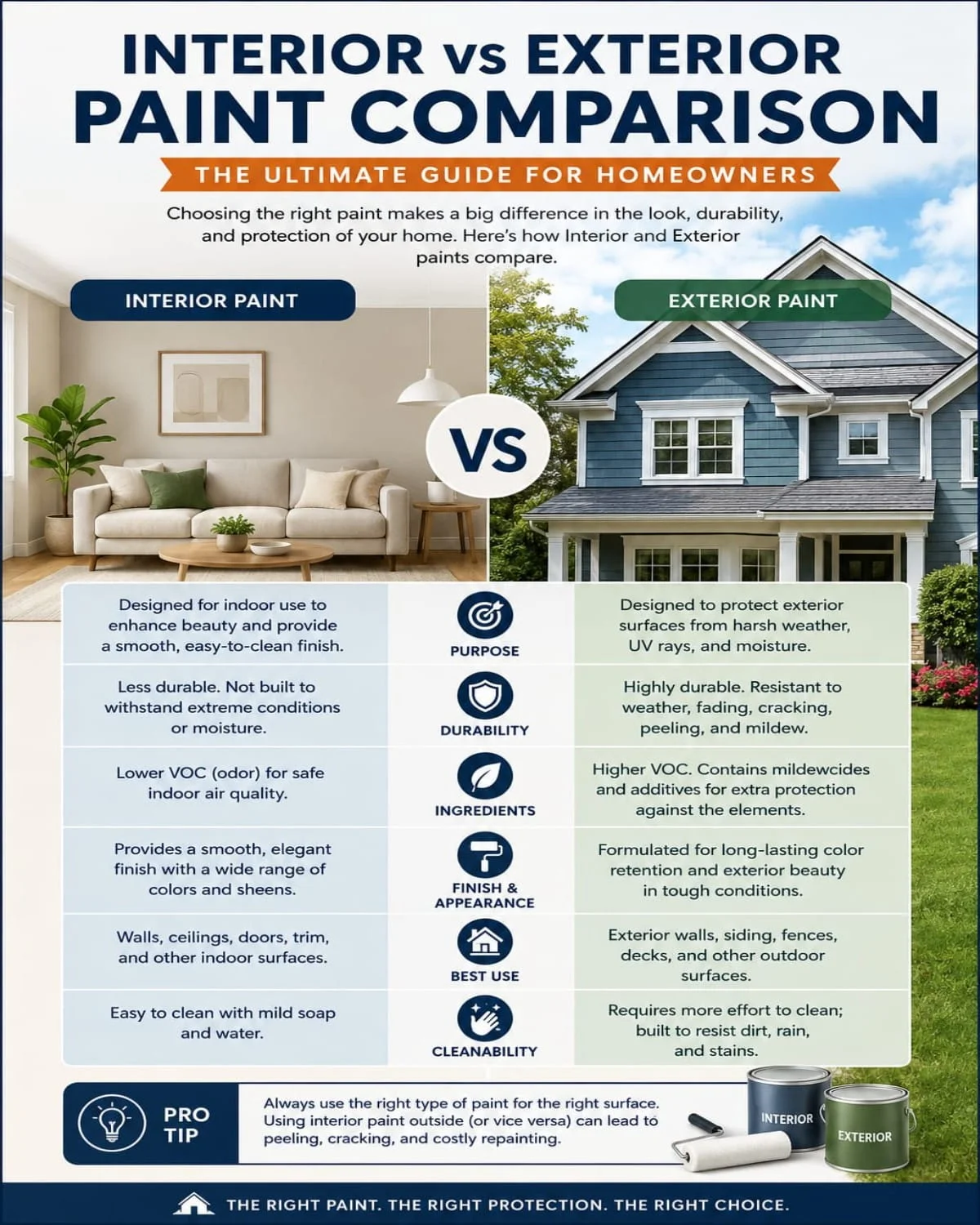
Interior vs Exterior Paint: Key Differences Explained
| Feature | Interior Paint | Exterior Paint |
| Resins/Binders | Stiff — tougher for scuff prevention | Flexible — designed to withstand swings in temperature |
| Additives | Flow and leveling agents | UV blockers, mildewcides, algaecides |
| VOC Levels | Low to zero | Generally higher |
| Main Job | Washability, stain resistance | Weatherproofing, fade resistance |
| Finish Options | Matte, eggshell, satin, semi-gloss, gloss | Flat, satin, semi-gloss |
| Where It Belongs | Walls, ceilings, trim, cabinets | Siding, decks, fences, exterior trim |
In short, this table captures the essence of the whole interior/exterior paint argument. If you have to, print it and tape it inside your garage door.
Can you use exterior paint inside?
Technically, yes. You can physically roll external paint on a bedroom wall. Nobody’s stopping you.
Should you? No. And here’s why.
Since exterior paint is higher in VOC, it was never designed to be used indoors. But run a fan with the windows open for just one day, and you might still detect it weeks later — especially in winter when everything’s shut tight. Others complain of headaches or that scratchy-throat feeling after using exterior paint inside—especially in small rooms where the air doesn’t circulate well.
Then there’s the proofing mismatch no one talks about. The soft, pliable resins are ideally suited to weathering, scuff, and scratches more easily than rigid interior formulations. And so you end up exchanging clean air for a wall that will easily dent if you lean up against it with your chair.
A few rare exceptions exist. Areas with plenty of air movement — where no one spends hours breathing in the fumes (like a very ventilated garage, workshop or unfinished basement) will likely be ok for exterior paint. But your kid’s bedroom? Hard no.
Can you use interior paint outside?
Same story, opposite direction. You can do it. You shouldn’t.
Unprotected interior paint on an outside wall fades quickly — in sunny areas such as Arizona or Florida, color visibly differs from the adjoining exterior within a single summer. That same paint cracks and peels as temperatures change seasonally from summer to winter, causing the surface to expand and contract — unless flexible resins are used.
Plus, interior paint avoids the mildewcide additives—so any moist area of your porch railing or fence becomes a buffet for mold and algae in just weeks after rainy weather.
I have witnessed this first-hand. One of my neighbours repainted her front porch railing with spare wall paint from the bedroom. Looked great in May. By August, it still was: bubbled, cracked and peeled in long strips exactly where the afternoon sun beat down hardest.
Can you use interior paint on an exterior? Nope, never a good idea.
What if I accidentally used interior paint outside?
Pro tip: No need to panic — this one happens far more than you think, not least due to that hidden stash of leftover cans that someone nabbed by mistake.
Here’s the fix:
- First, allow the damaged areas to unfold. If the paint has not begun to fail yet, wait a few weeks.
- Remove any areas that are cracking, peeling or chalking.
- Sand the rough edges smooth.
- Apply a quality exterior-grade primer.
- Complete with true exterior paint designed for that area.
Discovering it early will save you from the larger paint job later.
Why is exterior paint cheaper than interior paint?
This one throws people for a loop, because exterior paint sounds “harder”, right? A few reasons explain it:
- Exterior paint is typically sold in larger volumes during peak seasons, which reduces manufacturing costs per gallon.
- Higher pigment loads for more pronounced saturation are frequently a feature of premium interior lines — the pigment is one of the most expensive ingredients in a can.
- Low odor and “0 VOC” are marketing focal points for interior paint brands, but it also comes with an increased cost to formulate.
Not that exterior paint is sub-par. It simply is its pricing strategy and ingredient mix.
What is the best paint for asthma?
Opt for a zero-VOC interior paint, which is best when certified by Greenguard Gold. That certification means independent laboratory testing verified low chemical emissions, something that matters as much for someone with asthma and allergies — even in the dog days of summer.
Pass over the stuff marked “low-odor only” — that term does not equal low VOC. Read the can. If breathing health is a concern, stick with the likes of Benjamin Moore Natura or Sherwin-Williams Harmony and other zero-VOC lines.
Is October too late to paint outside?
Depends on what part of the world you are living in. Most exterior paints require their surface temperatures to be above 50°F for proper curing, and newer formulas have lowered that threshold to as low as 35°F.
Scenes collected in Georgia or Texas, for example, on an October afternoon, are often warm enough for a decent outside shift. In Minnesota or Maine? Especially since an early frost could ruin a fresh coat before it has fully cured.
Before committing, consult the ten-day ahead forecast and check this item on your paint can for its minimal application temperature. If in doubt about a coat cure time, err on the side of spring instead of rushing to finish ~ not every coating cures right.
What’s the hardest color to paint over?
No contest, dark reds and black. These pigments are very stubborn; even two full coats of new paint tend to bleed through.
The solution is to use a tinted primer — ideally gray for darker colors, applied under your topcoat. If you skip this step, expect ghosting or a pinkish hue saying hello from behind your new lighter color for months.
Safety, Ventilation & Health Considerations (IMPORTANT)
Paint products contain chemical compounds that may emit fumes during application and curing. Always ensure proper ventilation when painting indoors, especially when using solvent-based or higher VOC products. Individuals with asthma, allergies, or respiratory conditions should follow manufacturer safety instructions and consider certified low-VOC or zero-VOC products. This article is for informational purposes only and does not replace professional medical or safety advice.
Before you begin — a few pro tips
- Prep work is most of the job. Painters always say this, and they are right — cleaning your surface matters more than what paint brand you pick (although some brands do perform better).
- Match the sheen to the room. Semi-gloss in bathrooms and outside trim. Eggshell or satin is used where a softer look is desired – living rooms and bedrooms.
- Check that label every time. Whether application temperature, dry time between coats or recoat windows — these numbers vary from brand to brand and sometimes even product line within the same brands.
- Don’t skip primer on tricky surfaces. Always dedicate a primer coat to raw wood, dark existing colors or repairs rather than using an all-in-one paint-and-primer product.
More Than You Think: Safety and Ventilation Are Important
Interior paint, even low-VOC brands, stands to benefit from open windows and a box fan running for days or weeks. Your lungs will thank you.
Do not pour leftover exterior paint or solvent down the drain if you happen to have some. Every city will have a household hazardous waste drop-off site — searching your county’s program should direct you to the closest one.
The Bottom Line
Exterior and interior paint are basically not interchangeable — no matter how enticing that half-empty can in the garage is. Interior paint is designed for air purity and scrubbability. Exterior paint is designed to resist the aspects we cannot control.
Use the right can for the job, and your paint job lasts years, not months. Combine the two, and suddenly you’ll be visiting the hardware store sooner than you realize — holding that fan of forty shades of greige all over again.
Check the can before your next project. Better yet, if you have a large outdoor job, call a pro who handles this sort of thing every day.
Editorial Review Note: This article has been carefully reviewed and fact-checked for accuracy, clarity, and practical relevance before publication. The content has also been evaluated by an experienced painting professional to ensure the guidance reflects real-world application standards used in residential painting projects. Our goal is to provide trustworthy, experience-based information to help homeowners make informed decisions when choosing between interior and exterior paint systems.